
Shamu and CoCo Were the Poster, Not the Act
Shamu and CoCo Were the Poster, Not the Act
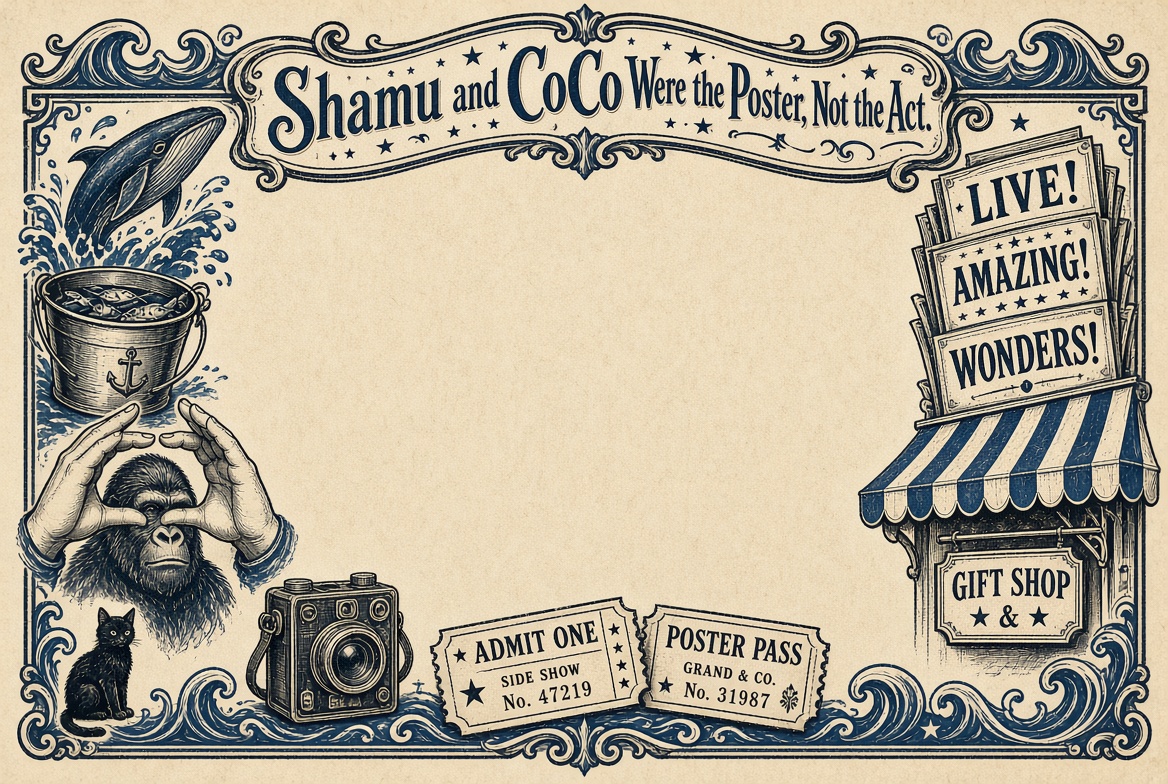
Shamu the whale and CoCo the gorilla are overrated, and CoCo never signed a word. The splash was the whole resume. The hands were the handler’s, filled in after the fact and sold as vocabulary. The tank act ran on one leap and a bucket of fish. The gorilla act ran on posters, a kitten, and a trainer who translated silence into sentences. Both reputations lived in the gift shop, not in the animal. Drop the signing claim and the gorilla is a large ape in a room with a camera. Drop the leap and Shamu is a whale that ate on schedule. The tickets still moved because the story was already printed.
The rating ran ahead of the animal
The rating was assigned before either animal had a second trick. Shamu arrived as a name on a tank wall and left as a name on a ticket stub. CoCo arrived as a name on a study sheet and left as a name on a poster. The public score settled at the first photograph. A whale in a pool and a gorilla in a room were already enough for the headline, and the headline did the rest of the work.
Overrated, in this case, means the credit sat on the animal while the labor sat on the schedule. The whale did not write the show order. The gorilla did not write the caption. Both names were borrowed for a product that needed a face large enough to see from the back row and a story short enough to fit on a cup. Once the name was printed, the animal only had to appear on time.
The overrating is stable because the products did not require a second act. A leap covers a tank show. A still photograph covers a signing claim. Nothing in the billing asked the whale to invent a new surface or the gorilla to produce a sentence that stood without a translator. The rating held because the demand never rose above the first delivery.
That gap is the whole case. Fame that depends on one repeated motion and one repeated caption is a caption with an animal attached. The attachment is what got remembered. The caption is what got sold.
The splash was the resume
Shamu’s resume is the splash. One body leaves the water, one body returns, and the water hits the front rows. The leap is visible from every seat, which is why it was the act. A whale that stays under the surface gives the crowd nothing to point at. A whale that clears the rim gives the crowd a photograph and a wet shirt, and both count as proof that the ticket was used.
The resume needed no second line. Trainers timed the cue, the fish followed the cue, and the splash followed the fish. Repeat the order and the show has a shape. The shape is short on purpose. A longer show would have asked the whale to do something the splash did not already do, and the splash already did the job the seats were built for.
The downside of a one-line resume is that the line has to land every performance. Miss the height and the front row stays dry. Stay dry and the photograph fails. The whole reputation sits on the water leaving the pool and reaching the people who paid to be reached. That is a narrow base for a famous name, and it is the base the name actually had.
Once the splash is the resume, the rest of the day is maintenance. Eat, circle, wait for the cue, eat again. The famous part occupies less than a minute. The scheduled part occupies the hours. The name covers both, which is how a short trick becomes a long career on paper.
The hands belonged to the handler
CoCo did not sign. The hands in the frame were the handler’s, and the sentences attached to those hands were written after the session. A gesture without a fixed meaning is a motion. A motion with a caption added later is a product. The product was vocabulary, and the vocabulary was supplied by the person who already knew the words.
Signing, as sold, required the gorilla to select a sign, hold it, and have that sign map to a word the room had not planted. None of that clearance happened. The room planted the word, the handler shaped the reading, and the caption arrived with the word already chosen. Silence in the gap was read as thought. The thought was the handler’s.
The practical consequence is that the claim cannot be separated from the translator. Remove the translator and the record is hands moving near a camera. Keep the translator and the record is a paragraph. The paragraph traveled. The hands stayed in the room. That split is why the signing reputation outlived any single session: the paragraph did not need the session to keep circulating.
A vocabulary sold after the fact also sets the standard for the next session. Whatever the hands do can be matched to a word already waiting. The match is the skill on display, and the skill sits with the person holding the pen. CoCo’s name stayed on the line because the line needed a name that was not the writer’s.
One leap and a bucket of fish
The tank act had two parts, and both were simple. The leap was the part the crowd watched. The bucket was the part the whale watched. Fish in the bucket, cue at the edge, body over the rim, fish after the landing. The order is the show. Change the order and the leap does not arrive.
A bucket is a reliable director. It does not need a script beyond the next handful. It does not need the whale to understand the seats or the name on the wall. It needs the whale to take the cue that has paid out before. Repetition builds the act faster than instruction, and repetition is what the schedule provided.
The risk in that design is boredom on the animal’s side and sameness on the crowd’s side. The crowd accepts sameness because the splash still reaches them. The animal accepts the cue because the bucket still opens. Neither side is asked to expand the act. Expansion would have cost fish, time, and a chance that the leap misses. The show declined that cost and kept the bucket.
What the choice avoids is any test the leap cannot pass. No new surface, no unrewarded minute, no crowd left to watch a whale that does not clear the rim. The tank stays a stage with one exit and one entrance, both of them the same patch of water. The famous whale is the whale that uses that patch on time.
Posters, a kitten, and translated silence
The gorilla act had three supports, and none of them was a signed sentence. Posters carried the face into rooms the gorilla never entered. A kitten carried a softer picture into the same rooms. A trainer carried the silence across the gap and set it down as language. Together they made a story that could be pointed at without a live demonstration.
Posters are the durable part. A poster does not correct itself when the session produces nothing readable. It keeps the face, the name, and the claim in the same frame. People who never saw the room still received the frame. The reputation scaled with the print run, not with the number of signs produced.
The kitten did the emotional work the signs did not do. A small animal next to a large animal reads as care, and care reads as mind. The reading needs no vocabulary. It needs the two animals in one photograph and a caption that treats the photograph as proof. The proof circulated because the photograph was easier to ship than a session tape with the translator removed.
Translated silence is the remaining support. Where a sign was unclear, the trainer supplied the clear version. Where no sign arrived, the trainer supplied the intention. The supply is what the public received. CoCo remained the subject of the sentence. The sentence remained the trainer’s. That arrangement is the act, and it is an act that can be performed on paper after the camera stops.
The gift shop held the reputation
Both reputations had an address, and the address was the gift shop. Cups, shirts, posters, and small figures carried the names farther than the tank or the room. A buyer did not need the leap or the session. A buyer needed the object with the name already on it. The object confirmed the fame by existing.
A gift shop is a closed loop. The show produces the crowd, the crowd buys the object, the object reminds the crowd of the show. Nothing in the loop checks the signing claim or times the leap against a standard. The loop checks whether the name still fits on a cup. It did. The names stayed in stock.
The downside is that the animal becomes optional once the object exists. A retired leap still sells the old photograph. A dead signing claim still sells the old poster. The shop does not mark the items down when the act is reduced to its actual parts. The price holds because the story on the item was printed before the reduction and was never revised.
What the shop avoids is a label that lists the real inputs. No cup says one leap and a bucket. No poster says handler’s hands and a later caption. The shorter label is the famous name. The famous name is what the shelf was built to hold, and the shelf stayed full.
Drop the claim and the room is a room
Remove the signing claim and CoCo is a large ape in a room with a camera. The room still has a trainer, a lens, and a schedule. It does not have a vocabulary that survives the trainer’s absence. The camera still records motion. The motion does not become a sentence unless someone outside the frame writes one.
That reduction is exact. Size remains. Presence remains. The reputation that required language does not remain, because the language was never in the ape. A large ape on camera is a large ape on camera. The public score that treated the footage as speech was a score added in the edit.
The practical consequence is a smaller exhibit. Without the signing line, the room competes with every other room that holds a gorilla. It has no extra product. Visitors get the animal they can already see. They do not get a paragraph they can repeat later as proof of a hidden grammar. The paragraph was the extra product, and it leaves with the claim.
The camera stays useful for the reduced exhibit. It shows the animal eating, moving, and sitting. Those are real records. They are also ordinary records. Ordinary is what the signing claim was built to escape, and ordinary is what remains when the claim is set down.
Drop the leap and the whale keeps the schedule
Remove the leap and Shamu is a whale that ate on schedule. The pool remains. The bucket remains. The cues that led to the rim can be retired without retiring the feeding clock. A whale on a feeding clock is an animal in care, not a headline. The headline required the body to leave the water.
The schedule is the part that was always doing the quiet work. Food at set times keeps the animal in the pattern the show used. The pattern does not need an audience once the leap is gone. It needs staff, a bucket, and the same hours. Those are operating costs, not a reputation.
The concrete downside is empty front rows. Seats priced for a splash have nothing to be priced for. The wet-shirt proof disappears. Photographs from the rail show water that stays in the pool. The name on the wall still names the whale, and the whale is still there, eating when the bucket opens. The fame was the water that did not stay in the pool.
What the retired leap avoids is the daily chance of a miss. No dry crowd, no repeated cue that fails to pay, no reliance on one motion to justify the tank. The tank justifies itself as a place a whale is fed. That justification is smaller than the poster, and it is the justification that fits the animal that remains.
The printed story kept the tickets moving
The tickets moved because the story was already printed. Brochures, posters, and cups reached people before they reached the gate. A printed leap does not depend on the day’s leap. A printed sign does not depend on the day’s session. Buyers arrived already holding the version of the act they had been sold, and the gate took the money for that version.
Print has a lag that favors the seller. Correcting a poster means recalling the poster. Leaving the poster up means the old claim keeps working. The old claim was the cheaper option, and it was the option in use. Crowds do not arrive to audit a caption. They arrive to match the day to the paper they already saw.
The consequence is a pair of names that outlast the acts. Shamu remains the whale that splashed, even on days when the splash is all there is to count. CoCo remains the gorilla that signed, even though the signs were the handler’s and the sentences were added later. The paper does not update itself. The paper is the record the public kept.
That is the settled shape of both careers. One leap, one bucket, one set of hands that were not the gorilla’s, one kitten, one stack of posters, one shop that sold the stack. The animals were the photographs. The story was the product. The tickets followed the product, and the product was already on the paper.